57.628107264
3.5709125
327
Falkland Islands - South Georgia - Elephant Island - Antarctica - Polar Circle
Expedition cruise from Ushuaia to sub Antarctic islands and the Antarctic Peninsula, aiming to reach and cross the Polar Circle if conditions allow.
On this voyage of 23 days/22 nights aboard MS Hondius you visit the Falkland Islands and South Georgia, follow the route south to Elephant Island, and then explore the Antarctic Peninsula with the goal of crossing the Polar Circle when conditions permit.
Tour ID: 1830753 Antarctica, South Shetland Islands, Antarctic Peninsula, South Georgia, Weddell Sea, Subantarctic Islands, Drake Passage, Falkland Islands, Deception Island, Elephant Island, South Orkney Islands ●●●●● 160 Reviews
15 days / 14 nights
Expedition ship m/v Hondius, m/v Plancius
Falkland Islands with Westpoint and Saunders
South Georgia with king penguins and Grytviken
Elephant Island and Point Wild
Antarctic Peninsula with Antarctic Sound and South Shetlands
Crossing the Polar Circle if conditions allow

Falkland Islands - South Georgia - Elephant Island - Antarctica - Polar Circle: The itinerary
Day 1: Ushuaia arrival and embarkation
Your journey begins in Ushuaia, Argentina, at the southern tip of South America on Tierra del Fuego. In the afternoon you embark on MS Hondius and begin the expedition. After check in there is time to familiarise yourself with the ship, safety procedures and the daily rhythm of an expedition cruise. The ship then departs and sails through the Beagle Channel for the rest of the evening, with mountains lining the waterway and providing a sheltered start. As the ship moves away from town, the scenery shifts from harbour views to broader channel landscapes. The first evening is mainly about settling in on board before the open ocean and the first island landings in the days ahead.
Day 2: Sea day with seabirds in the westerlies
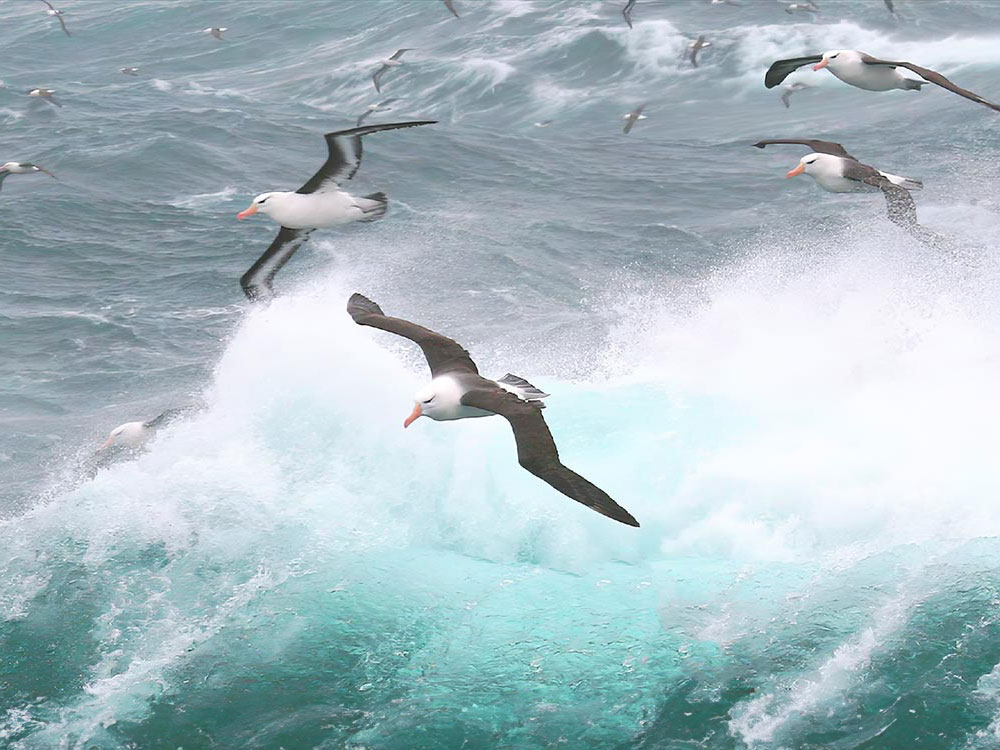
Today is a day at sea as MS Hondius heads toward the Falkland Islands. In the westerly winds, several seabird groups often follow the ship, including different albatross species, storm petrels, shearwaters and diving petrels. Observation from deck is a central part of the day, as many birds use the airflow above the waves and may remain close to the vessel for extended periods. Although this is a transit day, the birdlife and changing light and weather provide a clear sense of the sub Antarctic marine environment. On board there is time for briefings and information about the upcoming landings. This sea day forms the transition from departure in Ushuaia to the first shore visits in the Falklands.
All pictures of this partner


Day 3: Falkland Islands, possible landings on Westpoint or Saunders
You reach the Falkland Islands, known for rich wildlife and for the possibility of approaching many animals carefully and at close range. Outside the region the islands are often remembered mainly in connection with the 1982 conflict between the United Kingdom and Argentina, but the natural focus is on birdlife and coastal ecosystems. In surrounding waters, Peale’s dolphins and Commerson’s dolphins may be seen. During this part of the voyage, areas such as Westpoint Island may be visited, where shorebirds occur near the landing site and black browed albatrosses can be seen on nests. A colony of rockhopper penguins is also present, making a steep climb from the sea to nesting areas among the albatrosses. Alternatively or additionally, Saunders Island is possible, where black browed albatrosses, imperial shags and rockhopper penguins occur. King, Magellanic and gentoo penguins may also be found here, depending on location and season.
Day 4: Port Stanley, Falkland culture and history
Today focuses on Port Stanley, the Falklands’ capital. The town combines South American elements with a touch of Victorian character, visible in colourful houses, well kept gardens and English pubs. In the surrounding area you can see shipwrecks that serve as quiet reminders of the challenges of nineteenth century seafaring. A visit to the small museum is also possible, covering early settlement history through to the Falklands War. Museum admission is included. You explore the capital independently, with time for walking, photography or visiting specific sites. Around 2,100 people live in Port Stanley today, which underlines both the small scale of the settlement and the remoteness of the islands.
Day 5: At sea toward South Georgia, crossing the Antarctic Convergence
MS Hondius leaves the Falklands and sets course for South Georgia. On this route you cross the Antarctic Convergence. Within a few hours temperatures can drop noticeably, and as water masses collide, nutrient rich water rises to the surface. This ecological boundary attracts large numbers of seabirds that can often be observed close to the ship. Species may include several albatross types as well as shearwaters, petrels, prions and skuas. The day is planned as a sea day with an emphasis on observing and understanding these changes in ocean conditions and wildlife. It also provides time to prepare for the more demanding weather that often shapes operations in South Georgia. The passage continues south and east toward the island.
Day 6: Continuing toward South Georgia, open ocean and seabirds
The voyage remains at sea as the ship continues toward South Georgia. Conditions can be variable, and seabird watching remains an important part of the day. Near the convergence zone and in productive waters, albatrosses, petrels and other species may still accompany the ship or circle nearby. On board there is time to deepen the routine of expedition life and to receive information about planned landings in South Georgia. As you draw closer, cooler conditions and often different sea states become more noticeable. Arrival timing and the first activities depend on weather and visibility. This day completes the crossing and leads into the South Georgia landing programme.
Day 7: South Georgia, beginning activities under weather constraints
You reach South Georgia and begin activities if conditions allow. Weather can be challenging here and strongly influences planning. Landings and Zodiac operations are organised to use safe windows as they appear. South Georgia is characterised by steep coasts, glaciers and very large concentrations of wildlife, especially in breeding and resting areas. The days in this region therefore focus on observation and careful movement ashore, with flexible routing. The expedition team continuously decides on suitable sites and the order of visits. This begins a section where wildlife and landscape experience are closely linked to local weather.
Day 8: Fortuna Bay and a possible Shackleton route toward Stromness
One possible objective is Fortuna Bay, shaped by the presence of the Fortuna Glacier and known for king penguins and seals. If a landing is possible, you may have the opportunity to follow the final section of Shackleton’s route toward the abandoned whaling village of Stromness. The route crosses a mountain pass behind Shackleton’s Waterfall. Terrain can be partly boggy, and you should be prepared to cross small streams. The day combines a clear historical context with a walk in sub Antarctic terrain and observation of large wildlife concentrations. As with all South Georgia activities, execution depends on weather, wind and landing conditions. The focus remains on safe operations and experiencing the landscape at a measured pace.
Day 9: Salisbury Plain, St Andrews Bay or Gold Harbour, colonies and beaches
Other possible sites include Salisbury Plain, St Andrews Bay and Gold Harbour. These locations are known for hosting South Georgia’s three largest king penguin colonies and also for being among the world’s largest breeding areas for Antarctic fur seals. Depending on timing, young fur seals can be particularly curious and active. Large southern elephant seals also come ashore to moult. The day is designed for observation, with animal movement and beach conditions determining routes and viewing positions. Landings are made by Zodiac when possible, and time ashore is managed to allow wildlife viewing while moving safely near large colonies. The specific site chosen depends on weather and accessibility.
Day 10: Grytviken, museum and Shackleton’s grave, then sailing south
A visit to Grytviken is possible, an abandoned whaling station where king penguins now walk among the buildings and elephant seals rest along the shore. You can visit the South Georgia Museum and Shackleton’s grave. The site links industrial history, polar history and present day wildlife use of the area. Time in Grytviken depends on conditions and local procedures, as landings and movement are carefully managed. In the afternoon of Day 10, depending on weather and schedule, MS Hondius sails south toward the South Orkney Islands. This marks the end of the South Georgia phase and the transition into more distinctly Antarctic waters.
Day 11: Sailing farther south, drift ice and additional seabirds
On the route south you may encounter drift ice. If so, south polar skuas and snow petrels may join other seabirds and follow the ship. This is a sea day focused on observing ice conditions and birdlife. As you move closer to Antarctic waters, both species composition and sea conditions change. Routing is adjusted to ice, and the expedition team uses suitable periods for observation and interpretation. The day also prepares for possible landings in the South Orkney Islands. It forms the transition from sub Antarctic islands into the Antarctic zone.
Day 12: South Orkney Islands, Base Orcadas or Shingle Cove
Depending on prevailing conditions, the South Orkney Islands may be reached. One option is a visit to Base Orcadas, an Argentine scientific station on Laurie Island. If a visit is possible, station staff may show you around and provide insight into daily work in this remote environment. If this is not feasible, a landing at Shingle Cove on Coronation Island may be made instead. The decision depends on weather, ice and operational possibilities. In either case, the day offers the experience of a very remote island group often shaped by ice and rapidly changing conditions. The focus is either on a scientific context or on a more landscape based landing.
Day 13: Elephant Island, Point Wild and Shackleton context
You reach Elephant Island, having covered roughly the same distance, though in the opposite direction, as Sir Ernest Shackleton did in 1916 with the James Caird. The historical background is tied to the rescue of 22 members of the Endurance expedition stranded on Elephant Island. Conditions here are difficult, with a coastline dominated by steep rock faces and ice cliffs exposed to the elements. If possible, Zodiacs take you to Point Wild, where the stranded expedition members survived. The day is therefore highly dependent on weather, swell and ice, and it may be that only a ship based approach is possible. Interpretation of the events and observation of the coastline are central.
Day 14: Antarctic Peninsula, Antarctic Sound and possible landing at Brown Bluff
If ice allows, you sail into Antarctic Sound at the northwestern edge of the Weddell Sea. Large tabular icebergs often signal arrival at the eastern margins of the Antarctic Peninsula. Brown Bluff is a potential landing site where you may have the chance to set foot on the Antarctic continent. Planning depends on ice and wind, as accessibility can vary greatly. Alongside a possible landing, Zodiac cruising and observation among icebergs are often key elements. This day marks the start of more intensive peninsula exploration, with a stronger focus on ice landscapes and coastal forms. Wildlife sightings remain possible, especially near ice edges and in calmer waters.
Day 15: South Shetland Islands and Deception Island
The volcanic South Shetland Islands are often wind swept and can be foggy, but they also support diverse flora and fauna. Mosses, lichens and flowering grasses occur in sheltered areas, while gentoo and chinstrap penguins and southern giant petrels are typical wildlife. At Deception Island the ship enters the flooded caldera through Neptune’s Bellows. Here you find an abandoned whaling station and large numbers of cape petrels, as well as kelp gulls, brown and south polar skuas and Antarctic terns. Good walks are possible in this volcanic landscape, depending on conditions and expedition guidelines. The day combines geological features, wildlife observation and a site with historical remains.
Day 16: Gerlache Strait region, continuing Antarctic exploration
The voyage continues deeper into Antarctica, entering the Gerlache Strait region. The landscape is defined by grey peaks covered with snow, towers of broken blue white ice and a diverse mix of wildlife and plant life. This area includes some of the peninsula’s best known channels, and daily planning depends on ice, wind and visibility. Landings and Zodiac cruises are organised to use safe conditions when available. The day supports the transition into more intensive exploration of the peninsula region, where scenery and wildlife can change quickly over short distances. The overall aim remains to push farther south if conditions allow.
Day 17: Neko Harbour, glacier scenery and Zodiac perspectives
One possible site is Neko Harbour, known for a setting of large glaciers and wind shaped snowfields. Zodiac cruising often provides the best perspective on ice covered mountain peaks and the structure of glacier fronts. Depending on conditions, a landing may also be possible to experience the scale of the landscape from shore. The day remains focused on the interaction of ice, coastal forms and potential wildlife sightings. Sequence and timing depend on weather and ice, as conditions in bays and channels can change quickly. The expedition team adjusts plans accordingly to use safe and meaningful windows.
Day 18: Paradise Bay, Zodiac cruising and whale chances
Paradise Bay is a broad bay often scattered with ice, well suited for Zodiac cruising. During a cruise here there are good chances to see humpback whales and minke whales, depending on visibility and activity. The scenery is shaped by steep slopes, glaciers and calmer water surfaces where ice fragments can collect. The day focuses on observation and experiencing the bay at close range, with Zodiacs allowing flexible approaches to ice and shoreline features. Activities are adjusted to wind and ice to ensure safe operations. The wider objective remains to continue southward when feasible.
Day 19: Toward the Polar Circle, Crystal Sound and the Argentine Islands area
The aim remains to move farther south. If conditions allow, the voyage continues toward Crystal Sound, passing the Argentine Islands into waters often filled with ice. You are now close to the Polar Circle, which may be crossed in the morning if route and conditions permit. The day includes longer passages where ice conditions shape navigation. At the same time there is continued opportunity to watch for seabirds and marine mammals. The landscape at these latitudes often feels more open, with extensive ice and prominent mountain ranges in the background. The day therefore combines progress south with experiencing the scale of the Antarctic environment.
Day 20: Detaille Island, Pourquoi Pas Island or Horseshoe Island near and beyond the Circle
If conditions are favourable, sites near or beyond the Polar Circle may be reached. One option is Detaille Island, where a landing near an abandoned British research station may be possible, with high mountains and large glaciers in the surrounding area. Alternatively, the ship may sail around Pourquoi Pas Island, named after Jean Baptiste Charcot’s vessel and known for narrow fjords and high glacier filled mountains. Horseshoe Island is another possibility, home to the former British Base Y from the 1950s, now unstaffed but still retaining much of its equipment. Which sites are visited depends on ice, weather and timing. The day links landscape, research history and the experience of high southern latitudes.
Day 21: Drake Passage, familiar seabirds on the return
The return voyage begins with another crossing of the Drake Passage. The journey is not solitary, as many seabirds seen on the southbound crossing appear again. This time, many species feel more familiar, and observation from deck remains part of the daily routine. Sea conditions can vary, and routing is adjusted to weather and swell. On board there is time to organise impressions from the previous weeks and to receive information about arrival procedures. This is a classic sea day marking the transition from Antarctica back toward South America.
Day 22: Final sea day toward Ushuaia
The passage toward Ushuaia continues. Depending on weather, seabirds remain present and marine mammals may occasionally be seen. The day is primarily a transit, focused on a safe and steady crossing. On board, disembarkation procedures are prepared and final practical information is shared. There is also time to bring the voyage to a close, as the expedition has covered a wide range of islands, wildlife encounters and Antarctic landscapes. Toward the end of the day the ship approaches the waters around Tierra del Fuego again. This is the final night on board before returning to Ushuaia.
Day 23: Ushuaia disembarkation
You arrive in Ushuaia. The package ends after breakfast on board with disembarkation. You then continue your onward travel independently.
Included Falkland Islands - South Georgia - Elephant Island - Antarctica - Polar Circle
- Pre-arranged group transfer from the ship to the airport in Ushuaia (immediately after disembarkation)
- Luggage transfer from the designated pick-up point to the ship on the day of embarkation in Ushuaia
- Free use of rubber boots and snowshoes
- Complimentary Wi-Fi: each guest receives 1.5 GB of data per day, renewed every 24 hours
- Complimentary Dopper water bottle for use during and after your expedition
Additional Information for Expedition Cruises: The itinerary and route described are provided as examples only and may be adjusted or changed at any time due to weather, ice and tidal conditions, as well as for safety reasons. Specific landing sites, locations or route sections therefore cannot be guaranteed. The captain and expedition leader will make all final decisions regarding the route, landings and daily programme on site. Wildlife sightings cannot be guaranteed. Landings and Zodiac excursions depend on local conditions and regulatory requirements. Optional activities have very limited availability; we recommend booking them well in advance, often weeks or months before departure, as they may be fully booked by the time of travel; their operation depends on weather, ice and safety conditions as well as minimum participation. Polar regions are remote and dynamic natural environments, therefore programme changes or delays may occur.


.jpg_Julian Bourse.jpeg)


.jpg_Ignacio Marino.jpeg)


.jpg_Martin van Lokven.jpeg)
.jpg_Martin van Lokven.jpeg)
.jpg_Martin van Lokven.jpeg)


These pictures provide a general impression of our local partner and the surrounding area. Please note that selected tour may differ from these pictures.
All Reviews of Oceanwide Expeditions
●●●●● 4.6 of 5 Stars (160 Reviews) on
Help us and submit a new review
Please select between 1 to 5 to review the operator* ○○○○○
Sat. 13.02.2027 - Sun. 07.03.2027
23 days from Ushuaia, Argentina
Available on request
23 days from Ushuaia, Argentina
Available on request
from €16100,-


Available on request
from €16100,-
Deck: 3 15m² Shared Occupancy Quad Double Porthole

Available on request
from €20050,-
Deck: 3 13m² Twin Beds Double Porthole


Tue. 15.02.2028 - Wed. 08.03.2028
23 days from Ushuaia, Argentina
Available on request
23 days from Ushuaia, Argentina
Available on request
from €18250,-
Available on request
from €18250,-
Deck: 3 15m² Shared Occupancy Quad Double Porthole

Available on request
from €20450,-
Deck: 3 16m² Shared Occupancy Triple Double Porthole
Available on request
from €22350,-
Deck: 3 13m² Twin Beds Double Porthole

Available on request
from €23350,-
Deck: 4 12m² Twin Beds Standard Window

Available on request
from €26050,-
Deck: 6 19m² Twin Beds Panoramic Window

Available on request
from €27150,-
Deck: 6 21m² Twin Beds Panoramic Window
Wed. 23.02.2028 - Wed. 08.03.2028
15 days from Ushuaia, Argentina
Available on request
15 days from Ushuaia, Argentina
Available on request
from €11600,-


Available on request
from €11600,-
Deck: 2 12m² Shared Occupancy Quad Single Porthole


Available on request
from €14250,-
Deck: 3 12m² Twin Beds Single Porthole

Available on request
from €14850,-
Deck: 4 13m² Twin Beds Standard Window


Available on request
from €17250,-
Deck: 4 & 5 & 6 21m² Twin Beds Standard Window
All prices per person in double or multi-bed category. Single room surcharges, children's price advantages etc. on request.
Fixed travel dates, additional days on demand.
Fixed travel dates, additional days on demand.