62.350510648961
12.5429254
326
Falkland Islands, South Georgia & Antarctica 30% Advantage
An expedition from Ushuaia to sub Antarctic islands and the Antarctic Peninsula.
20 days/18 nights through the Falkland Islands Malvinas, South Georgia and the Antarctic Peninsula, with landings, lectures and sea days focused on wildlife, polar history and dramatic ice shaped landscapes.
Tour ID: 1830395 Antarctica, South Shetland Islands, Antarctic Peninsula, South Georgia, Drake Passage, Falkland Islands, Deception Island, Lemaire Channel ●●●●◐ 98 Reviews
20 days / 19 nights
Expedition ship Ocean Albatros, Ocean Victory, MS Seaventure
Falkland Islands Malvinas with seabird and penguin colonies
Stanley and Gypsy Cove
South Georgia with Grytviken and Shackleton’s grave
Antarctic Peninsula and South Shetland Islands
sea days with briefings and expert lectures
kayaking photography citizen science snowshoeing

Falkland Islands, South Georgia and Antarctica: Itinerary
Day 1: Arrival in Ushuaia and time to explore
After landing at the airport, you will receive a friendly welcome and be transferred to one of the partnered premium hotel resorts set in Patagonian surroundings. The rest of the day is yours to rest after the journey or to explore Ushuaia independently, often described as the southernmost city in the world. Depending on your interests, you may take a walk, visit the waterfront, or simply get a first sense of the town before the expedition begins. In the evening, an optional briefing is offered, giving you the chance to ask questions and meet some of your fellow travelers. This first day sets a calm, practical framework for what follows, with nature observation and contextual knowledge as the central themes.
Day 2: Embarkation
Your morning remains unstructured and can be spent relaxing at the hotel, visiting a museum, or browsing shops in Ushuaia. In mid afternoon you will be escorted to the ship, where the Expedition Team and ship staff will welcome you on board and help you get settled. After you have familiarized yourself with the vessel, a safety and orientation briefing follows, outlining procedures that will be relevant throughout the voyage and during landings. The day concludes with the Captain’s welcome dinner, marking the formal start of the expedition. As the ship departs, the route turns toward the South Atlantic and onward toward Antarctica, with the first hours at sea offering a clear sense of the journey’s scale.
All pictures of this partner


Day 3: Southern Ocean
As the ship continues south, the day is shaped by key briefings on environmental regulations and expedition safety. These sessions provide the practical foundation for responsible travel in sensitive polar regions and for the routines used during shore operations. In parallel, the onboard program begins in earnest as scientific and environmental specialists introduce the wildlife, history and geology of the areas you will soon be visiting. Sea days are therefore not only transit time, but also preparation, helping you recognize species and understand the broader context of the landscapes ahead. Weather and sea conditions vary, and many guests spend time on deck observing the ocean environment and the changing light. The combination of structured information and open observation sets the tone for the expedition phase of the voyage.
Day 4: West Falklands Malvinas
Today you explore some of the westernmost settled outposts in the Falkland Islands Malvinas, a remote South Atlantic archipelago known for rugged terrain and cliff lined coasts. Walks across farmland and along beaches provide opportunities to visit albatross and penguin colonies. With patience and good viewing conditions, you may see Rockhopper penguins as well as King and Magellanic penguin rookeries. The open, wind shaped landscape and the coastal setting often make bird activity easy to follow. The day is primarily dedicated to wildlife observation and understanding the character of these islands before the voyage continues eastward.
Day 5: Stanley, East Falklands Malvinas
Stanley is the archipelago’s main settlement, located in a sheltered harbor and functioning as a local hub. A visit to the Falkland Islands Museum offers exhibits on maritime exploration, natural history and the 1982 Falklands War. The program often includes Gypsy Cove on the Cape Pembroke peninsula, a National Nature Preserve. Magellanic penguins breed here, nesting in underground burrows and known for their distinctive braying calls. Other native bird species may include Black crowned night herons, Long tailed meadowlarks, Two banded plovers, and Upland and Kelp geese. Nearby Ordinance Point is associated with several World War II era guns, adding another historical layer to the visit.
Day 6: Southern Ocean
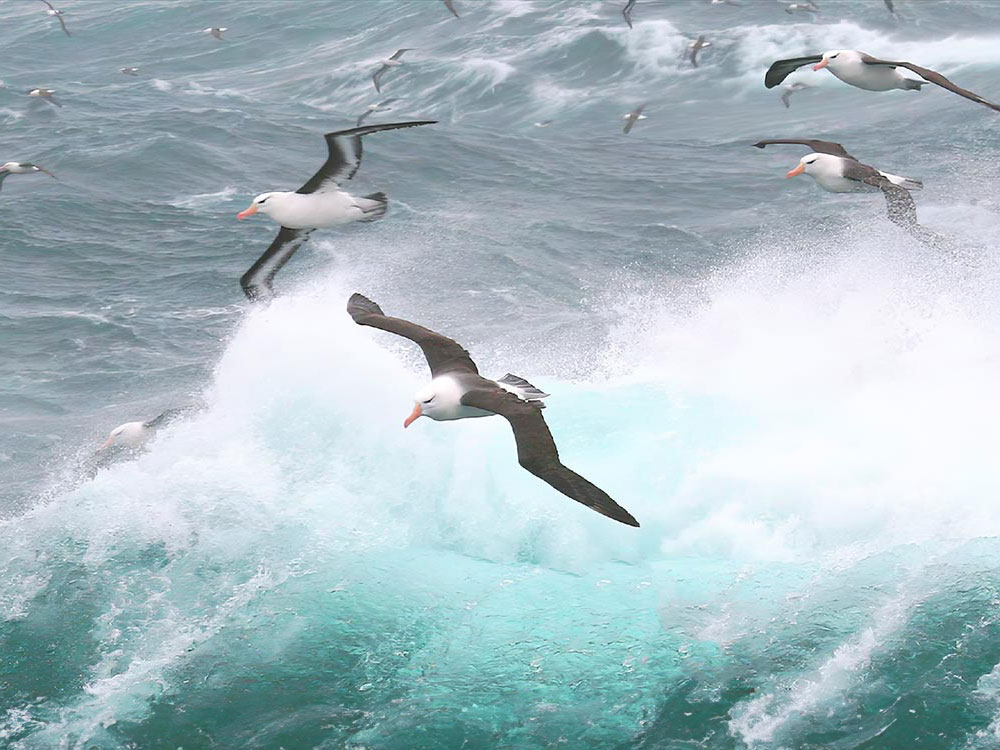
As the ship heads east and approaches the Antarctic Convergence, wildlife sightings often increase and the voyage officially enters Antarctic waters. From the deck, you may be able to identify the Wandering albatross, widely recognized as the world’s largest bird. Other species, from the Southern giant petrel to the much smaller Wilson’s storm petrel, can be seen using the updrafts created by ocean swells. The onboard lecture program continues, supporting identification skills and providing context for the next stages of the route. Guests are also encouraged to watch for whale blows, and this part of the crossing is often when the first iceberg is spotted. The day combines transit with observation and preparation.
Day 7: Southern Ocean
The second sea day in this segment continues the gradual transition into colder waters. Conditions at sea can change quickly, and the Expedition Team provides guidance on safe movement on deck and on how daily plans may adapt. Many travelers use the time to observe seabirds systematically, comparing flight patterns and field marks, while others attend additional presentations on polar history and ecology. Ice sightings may become more frequent as the route progresses, and the ocean environment begins to look and feel distinctly different from earlier days. This steady, information rich passage supports a clear understanding of the region before reaching South Georgia. By the end of the day, the expedition rhythm is well established.
Day 8: South Georgia
South Georgia is often referred to as the Serengeti of the Southern Ocean due to the large numbers of breeding penguins, seals and seabirds. Along the island’s leeward coast, mountain scenery, glaciers and sculpted icebergs form a striking setting for wildlife observation. Depending on landing sites and conditions, the day may focus on beaches and colonies where animal behavior can be observed at close range while maintaining appropriate distance. The Expedition Team supports interpretation and provides guidance on how to move responsibly in these environments. South Georgia also carries strong historical significance linked to the era of Antarctic exploration and maritime industry. The day balances natural history with this broader context.
Day 9: South Georgia
Exploration continues with further opportunities to visit different coastal areas and bays. The combination of steep slopes, glacier fronts and sheltered shorelines creates varied habitats, and wildlife concentrations can be substantial. Guides assist with species identification and explain breeding cycles, feeding behavior and ecological relationships. Historical traces remain part of the experience, as many sites reflect earlier human activity in the region. Plans are adjusted according to weather and sea state to ensure safe landings and operations. This flexibility is a defining feature of expedition travel and shapes the daily schedule. The overall focus remains on careful observation and informed understanding.
Day 10: South Georgia
A key visit may be the historic whaling station at Grytviken, which includes the small cemetery where Sir Ernest Shackleton is buried. This site provides a direct connection to the history of Antarctic exploration and the human narratives associated with the Southern Ocean. Beyond the historical elements, the surrounding area continues to offer strong wildlife viewing, with penguins, seals and seabirds commonly present. The landscape often shows sharp contrasts between dark rock, bright ice and the muted colors of vegetation in more protected areas. Onboard, additional context may be provided on the whaling era and its environmental consequences. The day links place based history with the living ecosystem around it.
Day 11: South Georgia
The final day in South Georgia is typically used to deepen observations and, conditions permitting, to visit additional beaches or colonies before heading farther south. Many guests take time to focus on details, from animal interactions to the shapes and movement of ice in coastal waters. The Expedition Team may summarize key points and prepare everyone for the next crossing into more ice rich regions. Practical information about upcoming operations and environmental guidelines can also be revisited. As the ship departs, this section of the voyage concludes with a clear sense of South Georgia’s combination of high wildlife density and dramatic mountain scenery. The route then turns toward the Scotia Sea.
Day 12: Scotia Sea
Traveling farther south, you cross the Scotia Sea. Presentations and briefings continue on board, and time on deck remains important for wildlife spotting. Icebergs generally become larger and more numerous in this region, changing the visual character of the seascape. The Expedition Team may explain iceberg formation, drift patterns and the role of currents and temperature boundaries. Seabirds remain a regular presence, and whale sightings are still possible. The day is therefore a mix of transit, observation and preparation for the Antarctic Peninsula. The overall pace remains steady and expedition focused.
Day 13: Scotia Sea
The passage through the Scotia Sea continues, with increasing ice presence often marking the approach to Antarctica. Daily routines alternate between deck observation and the onboard program, depending on weather and sea conditions. Lectures may deepen themes such as Antarctic ecosystems, exploration history or the geological processes shaping the region. Outside, icebergs appear in a wide range of forms and sizes, and the opportunity to spot whale blows remains. These sea days provide a structured transition from the sub Antarctic islands to the Antarctic Peninsula. By the end of the day, the destination feels close and the operational briefings become increasingly relevant.
Day 14: Antarctic Peninsula and South Shetland Islands
Over the next days you explore the Antarctic Peninsula and the South Shetland Islands. The plan typically includes navigating iceberg rich channels and visiting a selection of bays and well known anchorages, as conditions allow. There are opportunities to observe penguin species, seals and whales along rugged coastlines and in surrounding waters. Depending on the route, visits to active scientific bases and historic landing sites may be possible, offering insight into research and earlier expeditions. The Expedition Team supports landings with safety guidance and environmental rules. The focus remains on careful observation and responsible access to a sensitive region.
Day 15: Antarctic Peninsula and South Shetland Islands
Exploration continues with additional potential stops in sheltered bays and along distinctive coastal sections. Maneuvering through ice is part of the expedition character and requires flexible planning based on visibility, wind and ice movement. Landings allow time to move through the landscape and observe wildlife at close range while maintaining appropriate distance. From the ship, seals on ice and seabirds in flight are often visible. Onboard, further context is provided on research activity, climate and the specific features of Antarctic habitats. The day balances time ashore with time at sea in a structured way.
Day 16: Antarctic Peninsula and South Shetland Islands
Depending on conditions, today may include visits to additional scientific or historic sites that illustrate human presence in Antarctica. Wildlife remains central, with regular opportunities to observe animals along the coast and in the water. Icebergs and glacier fronts shape the scenery and can change noticeably with weather and light, which is relevant for photography. The Expedition Team assists with interpretation, including geology and landscape formation, and answers questions that arise during landings. Environmental guidelines continue to be emphasized to minimize impact. The day follows the expedition principle of adapting to local conditions while maintaining clear priorities.
Day 17: Antarctic Peninsula and South Shetland Islands
The final day in this area is often used for further landings or Zodiac cruising before the northbound return begins. Many guests use the time to complete observations and to take in the variety of coastal settings one more time. The Expedition Team may offer summaries and address remaining questions about wildlife, history and research. Attention also turns to the upcoming crossing of the Drake Passage, and practical information may be shared accordingly. As always, the schedule can change at short notice due to weather and ice. With departure from the area, the Antarctic portion of the voyage comes to a close.
Day 18: Drake Passage
The return route leads north across the Drake Passage. On board, time is available for discussion, review and continued programming while the ship crosses open waters. Many travelers use these days to organize notes and photographs or to attend final talks. Seabirds are often present, and sea conditions can range from calm to more active. The Expedition Team continues to provide safety guidance and updates based on weather and sea state. This structured transit supports a gradual shift from expedition mode toward return travel. Ushuaia becomes the next fixed point on the route.
Day 19: Drake Passage
The second day of the Drake Passage is typically dedicated to concluding the expedition. A special slideshow is often presented to summarize the journey, followed by a final meal together. There is also time for practical information related to disembarkation and onward travel. On deck, seabird observation may continue as the ship approaches South America. The day is generally quieter and provides space to reflect on the previous weeks. By the end of the day, the voyage is nearing its endpoint. The next morning brings arrival procedures in Ushuaia.
Day 20: Disembarkation in Ushuaia and departure
Disembarkation takes place in Ushuaia in the morning. The travel package ends after disembarkation. From here you can catch a flight to Buenos Aires or extend your stay in Ushuaia independently for additional sightseeing and activities.
Additional Information for Expedition Cruises: The itinerary and route described are provided as examples only and may be adjusted or changed at any time due to weather, ice and tidal conditions, as well as for safety reasons. Specific landing sites, locations or route sections therefore cannot be guaranteed. The captain and expedition leader will make all final decisions regarding the route, landings and daily programme on site. Wildlife sightings cannot be guaranteed. Landings and Zodiac excursions depend on local conditions and regulatory requirements. Optional activities have very limited availability; we recommend booking them well in advance, often weeks or months before departure, as they may be fully booked by the time of travel; their operation depends on weather, ice and safety conditions as well as minimum participation. Polar regions are remote and dynamic natural environments, therefore programme changes or delays may occur.


.jpg)
.jpg)
.jpg)
.jpg)


.jpg)
.jpg)


.jpg)
.jpg)


.jpg)


These pictures provide a general impression of our local partner and the surrounding area. Please note that selected tour may differ from these pictures.
All Reviews of Polar Latitudes
●●●●○ 4.0 of 5 Stars (12 Reviews) on Tripadvisor●●●●◐ 4.3 of 5 Stars (86 Reviews) on Google
Help us and submit a new review
Please select between 1 to 5 to review the operator* ○○○○○
Sat. 09.01.2027 - Thu. 28.01.2027
20 days
Available on request
20 days
Available on request
from €21468,-
30% Advantage
30% Advantage


Available on request
from €21468,-
Deck: 4 17m² Triple Occupancy Standard Window

Available on request
from €23463,-
€24697,-
5% Advantage
5% Advantage
Deck: 3 17m² Twin Beds Double Porthole

Available on request
from €25557,-
€28396,-
10% Advantage
10% Advantage
Deck: 4 & 5 17m² Twin Beds Standard Window

from €27335,-
€39049,-
30% Advantage
30% Advantage
Deck: 7 30m² Twin Beds Large Balcony

Available on request
from €27490,-
€31239,-
12% Advantage
12% Advantage
Deck: 6 20m² Twin Beds Private Balcony
Sat. 16.01.2027 - Thu. 04.02.2027
20 days
Available on request
20 days
Available on request
from €19703,-
15% Advantage
15% Advantage


Available on request
from €22909,-
€26951,-
15% Advantage
15% Advantage
Deck: 3 & 4 13m² Twin Beds Single Porthole

Available on request
from €24238,-
€28515,-
15% Advantage
15% Advantage
Deck: 7 14m² Twin Beds French Balcony

Available on request
from €25411,-
€29895,-
15% Advantage
15% Advantage
Deck: 4 & 6 18m² Twin Beds Private Balcony

Available on request
from €26193,-
€30815,-
15% Advantage
15% Advantage
Deck: 4 & 6 22m² Twin Beds Private Balcony

Available on request
from €27523,-
€32379,-
15% Advantage
15% Advantage
Deck: 4 25m² Twin Beds Private Balcony

Available on request
from €30182,-
€35507,-
15% Advantage
15% Advantage
Deck: 6 26m² Twin Beds Large Balcony

Available on request
from €31433,-
€36979,-
15% Advantage
15% Advantage
Deck: 7 36m² Twin Beds Large Balcony

Available on request
from €36672,-
€43143,-
15% Advantage
15% Advantage
Deck: 4 42m² Twin Beds Large Balcony
Wed. 10.02.2027 - Mon. 01.03.2027
20 days
Available on request
20 days
Available on request
from €17982,-
15% Advantage
15% Advantage


Available on request
from €20954,-
€24651,-
15% Advantage
15% Advantage
Deck: 3 & 4 13m² Twin Beds Unobstructed Porthole

Available on request
from €22205,-
€26123,-
15% Advantage
15% Advantage
Deck: 7 14m² Twin Beds French Balcony

Available on request
from €23222,-
€27319,-
15% Advantage
15% Advantage
Deck: 4 & 6 18m² Twin Beds Private Balcony

Available on request
from €23926,-
€28147,-
15% Advantage
15% Advantage
Deck: 4 & 6 22m² Twin Beds Private Balcony

Available on request
from €25177,-
€29619,-
15% Advantage
15% Advantage
Deck: 4 25m² Twin Beds Private Balcony


Available on request
from €27523,-
€32379,-
15% Advantage
15% Advantage
Deck: 6 30m² Twin Beds Large Balcony

Available on request
from €28774,-
€33851,-
15% Advantage
15% Advantage
Deck: 7 36m² Triple Occupancy Private Balcony

Available on request
from €33544,-
€39463,-
15% Advantage
15% Advantage
Deck: 4 42m² Triple Occupancy Private Balcony

Available on request
from €40739,-
€47927,-
15% Advantage
15% Advantage
Deck: 7 50m² Shared Occupancy Family Panoramic Window
Mon. 27.12.2027 - Sat. 15.01.2028
20 days
Available on request
20 days
Available on request
from €23300,-
15% Advantage
15% Advantage
Available on request
from €23300,-
€27411,-
15% Advantage
15% Advantage
Deck: 3 & 4 13m² Twin Beds Single Porthole

Available on request
from €23547,-
Deck: 3 18m² Triple Occupancy Single Porthole
Available on request
from €25881,-
€30447,-
15% Advantage
15% Advantage
Deck: 4 & 6 18m² Twin Beds Private Balcony
Available on request
from €26663,-
€31367,-
15% Advantage
15% Advantage
Deck: 4 & 6 22m² Twin Beds Private Balcony
Available on request
from €27992,-
€32931,-
15% Advantage
15% Advantage
Deck: 4 25m² Twin Beds Private Balcony
Available on request
from €30651,-
€36059,-
15% Advantage
15% Advantage
Deck: 6 26m² Twin Beds Large Balcony
Available on request
from €31980,-
€37623,-
15% Advantage
15% Advantage
Deck: 7 36m² Twin Beds Large Balcony

Available on request
from €35323,-
Deck: 3 14m² Solo Cabin Single Porthole
Available on request
from €37298,-
€43879,-
15% Advantage
15% Advantage
Deck: 4 42m² Twin Beds Large Balcony
All prices per person in double or multi-bed category. Single room surcharges, children's price advantages etc. on request.
Fixed travel dates, not extendable.
Fixed travel dates, not extendable.